Online Agentic AI coaching exclusively for senior IT professionals, led by a Google Developer Expert (AI)
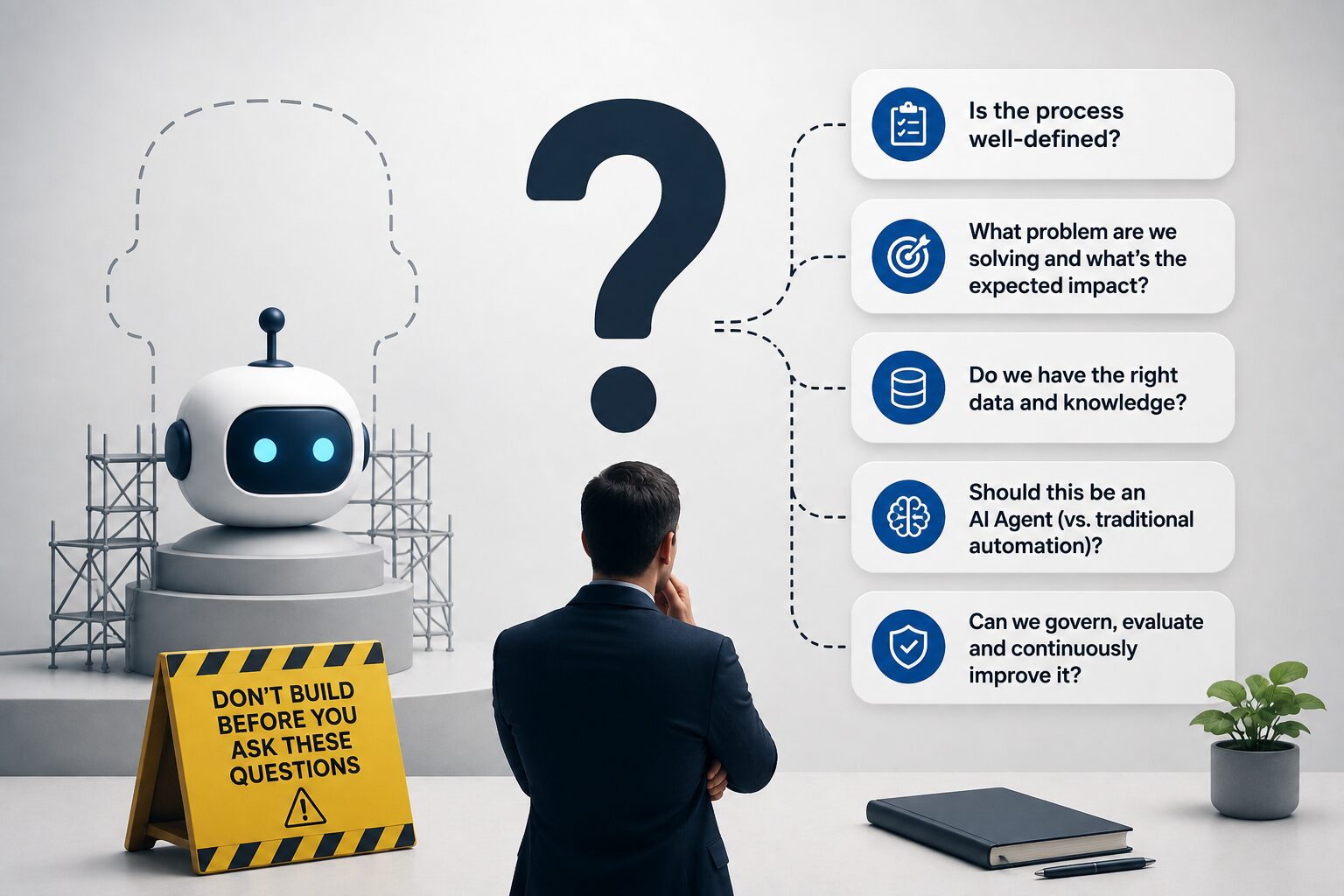
Before you build AI Agents in your Organisation, ask these 5 Questions

Reading Time: 3 minutes
It seems nowadays every CXO presentation has a “Let’s build an AI agent.” slide
But before you start doing that, let’s understand how you should build it with an AI recruitment Agent example
Imagine your Organisation wants to build an AI Recruitment Agent
How should you approach it?
1. Is the recruitment process documented?
Before thinking about AI, ask your HR team:
- How does a candidate enter the hiring pipeline?
- Who screens the resume?
- What determines whether a candidate is shortlisted?
- Who schedules interviews?
- How is interview feedback collected?
If every recruiter gives a different answer, stop.
Don’t build an AI agent.
AI agents automate processes, they don’t create them.
Start by documenting the hiring workflow as a step-by-step process.
Only then should AI enter the conversation.
2. Do you know what recruitment currently costs?
Before building anything, establish a baseline.
For example:
- Recruiters spend 30 hours every week screening resumes.
- Hiring managers spend another 12 hours reviewing shortlisted candidates.
- The average time-to-hire is 45 days.
- Around 40% of interviews are scheduled manually.
- Nearly 20% of candidate emails require repetitive responses.
Now you know what success looks like.
If an AI agent reduces screening time by 60% or shortens hiring by two weeks, you can actually measure the impact.
Without a baseline, every AI Agent project becomes a guessing game.
3. Does this task actually need an AI agent?
This is where many teams over-engineer the solution.
Not every recruitment activity requires reasoning.
For example:
- Sending interview reminders
- Creating calendar invitations
- Moving candidates between recruitment stages
- Updating the Applicant Tracking System (ATS)
These are deterministic workflows.
Traditional automation can handle them perfectly.
Now consider a different set of tasks:
- Comparing resumes against a job description
- Answering candidate questions
- Recommending the next best candidate
- Explaining why one candidate is a stronger fit than another
These require judgment and reasoning.
That’s where AI begins to add real value.
A simple rule of thumb:
Rules -> Automation
Reasoning -> AI Agent
4. Does the process require continuous decision-making?
Suppose the preferred candidate declines the offer.
Now what happens?
The system might need to:
- Find the next best candidate.
- Notify the recruiter.
- Schedule another interview.
- Update the ATS.
- Inform the hiring manager.
- Remember previous interview feedback.
This is no longer a simple “input -> output” task.
The system is making decisions throughout the hiring journey.
That’s where AI agents shine.
5. Should you build or buy?
Now we finally arrive at the classic Build vs. Buy decision.
Start by asking:
Can an existing recruitment platform already solve 80–90% of our problem?
Many recruitment platforms already provide AI-powered resume screening, interview scheduling, candidate communication, and analytics.
If your hiring process is fairly standard, buying will usually be faster, cheaper, and easier to maintain.
However, there are two situations where building becomes a much stronger option.
a) Your recruitment process is your competitive advantage
Suppose your company hires AI researchers, cybersecurity engineers, or chip designers.
Your hiring process includes:
- Custom technical evaluations
- Internal competency frameworks
- Proprietary interview rubrics
- Unique approval workflows
At this point, your recruitment process becomes part of your competitive advantage.
Building gives you the flexibility to tailor the agent to your unique hiring process.
b) Your data is too sensitive to outsource
Recruitment often involves:
- Candidate resumes
- Internal hiring plans
- Future organisational structures
- Confidential business projects
If you’re uncomfortable sending this information to an external AI platform, building an internal solution may be the better long-term choice.
Sometimes control matters more than convenience.
A business-first framework for building AI Agents
Notice something important.
We didn’t start with the technology.
We started with the business problem.
That’s the difference between building an AI demo and building an AI system that creates measurable business value.
The same framework works beyond recruitment.
Whether you’re considering AI agents for customer support, finance, procurement, legal, sales, or IT operations, ask the above questions first.
Agentic AI courses exclusively for senior IT professionals
If you’re a senior IT professional looking to design and lead real AI systems, I run instructor-led, live Agentic AI programs focused on production trade-offs, and decision-making.
You can explore the programs here: https://www.aimletc.com/online-instructor-led-ai-llm-coaching-for-it-technical-professionals/
If you have questions, feedback, or disagree with something in this article, I’d love to hear your perspective. Connect with me on LinkedIn:
https://www.linkedin.com/in/nikhileshtayal/
Common questions about the programs are answered here:
https://www.aimletc.com/faqs-ai-courses-for-senior-it-professionals/