Share it with your senior IT friends and colleagues
Reading Time: 6minutes
Unless you’ve been living under a rock, you probably know by now that the real complexity of building AI agents doesn’t lie in the model.
It lies in managing memory, tools, context, orchestration, security and reliability around the model.
If AI agents have to become increasingly autonomous, the infrastructure surrounding the model matters just as much as the model itself.
This emerging discipline is what people call Harness Engineering.
In this article, lets deep dive into the topic without any Jargon and in simple language
Lets start with the basic term – Harness
What is Harness in Agentic AI?
In short, a harness is the fixed architecture that turns a model into an agent.
A useful analogy is to think of the model as the engine and the harness as the car.
An engine by itself is powerful, but without steering, brakes, and controls, it cannot take you anywhere.
In fact, you are probably already using harnesses without realizing it.
Tools like Claude Code, Cursor, Codex, and Windsurf are examples of modern harnesses.
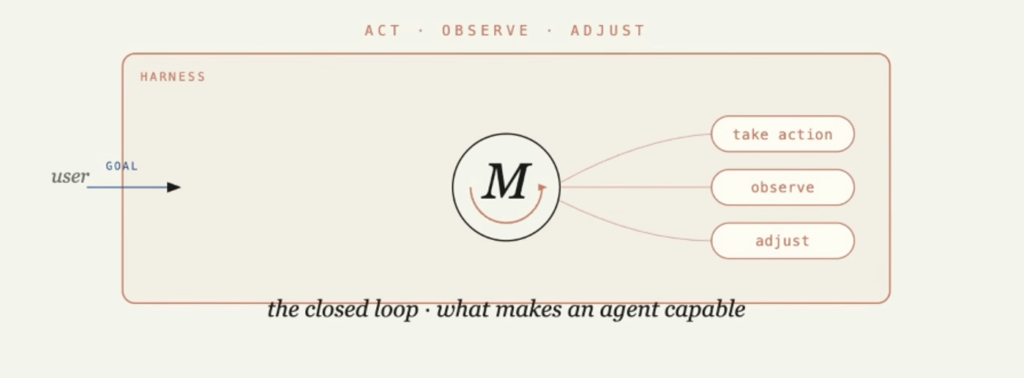
These systems provide the surrounding architecture that transforms the model into an agent capable of acting, observing, and adapting to achieve goals.
Difference between Frameworks and Harnesses
Before we talk about Harness engineering in details, lets talk about how it is different from AI Agents framework because the terms are often used interchangeably.
However, they solve very different problems.
A framework provides building blocks and abstractions for developing agents.
It gives you components such as tool calling, memory primitives, workflows, and APIs, allowing you to assemble your own agentic systems.
Examples include LangGraph, CrewAI, AutoGen, etc..
A harness, on the other hand, is the concrete runtime architecture that surrounds the model. It is responsible for state management, context assembly, tool execution, observation, retries, evaluation, and the closed-loop behavior that makes an agent capable.
In simple words, framework is built for humans to create AI Agents, while Harness is built for the agents to successfully do their tasks.
Humans then only provide the goal, the harness helps in handling the rest.
Ok, even if its not clear, then lets talk about harness components to make it crystal clear.
Components of a Modern Agent Harness: What’s inside?
A harness is much more than a wrapper around a model.
It is a collection of components that work together to transform token prediction into goal-directed behavior.
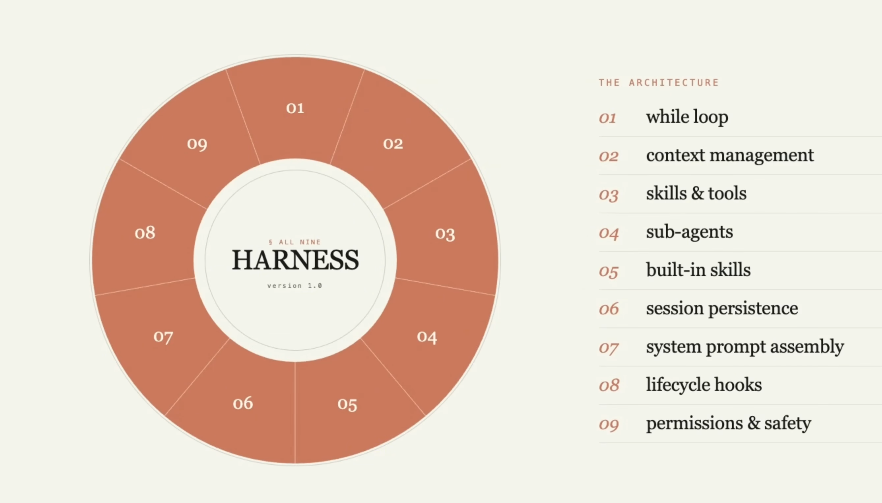
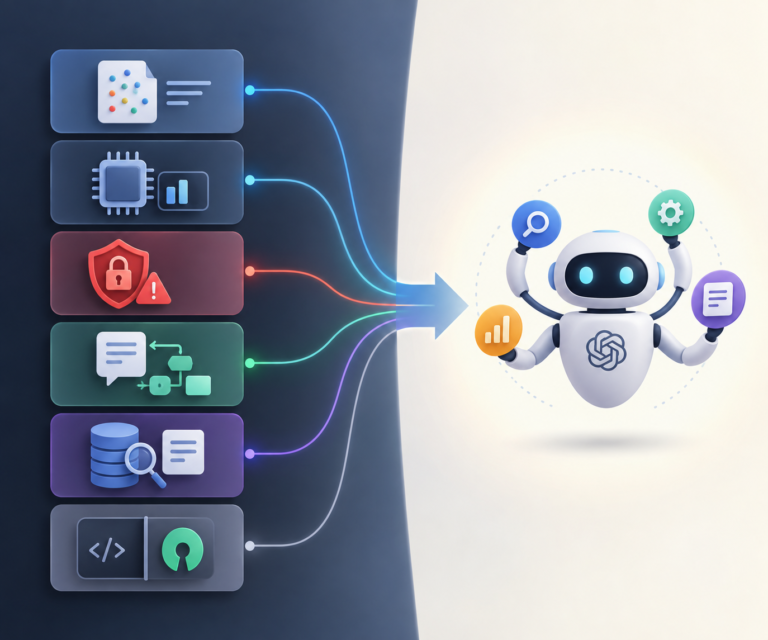
While implementations vary, most modern harnesses consist of nine core components:
1. The While Loop
At the heart of every agent harness lies a deceptively simple construct:
while not done:
response = model(messages)
if response.is_text:
break
result = dispatch(response.tool_call)
messages.append(result)
This loop is what transforms a model from a one-shot text generator into an autonomous agent.
The model decides what action to take.
The harness executes that action and feeds the result back to the model.
The process repeats until the model determines that the task is complete and returns a final text response.
This Act → Observe → Adjust cycle is the essence of agency.
The loop may run for a few iterations or hundreds, but the underlying pattern remains the same:
Decide what to do next.
Execute the action.
Observe the result.
Feed it back to the model.
Repeat until done.
Without this iterative loop, the model simply predicts tokens.
With it, the model can reason, act, and adapt towards a goal.
In many ways, the while loop is the beating heart of the harness.
2. Context Management
Every agent operates under a finite context window.
As conversations grow longer and tool calls accumulate, the harness must continuously decide:
What should be kept?
What should be summarised?
What should be dropped?
This process is known as context management, and it is arguably one of the most important responsibilities of a modern harness.
A typical context contains:
User messages
Tool calls
Tool results
Intermediate reasoning
Retrieved documents
Memory
Recent interactions are usually preserved verbatim, while older information is compressed into summaries.
Once the context reaches a predefined threshold (for example, 80% of the context window), the harness may trigger a compaction process to reclaim space.
3. Skills & Tools
So, we already know tools, but what are skills?
A skill is a higher-level capability built by combining one or more tools with domain-specific instructions.
For example, a git_commit skill might use file operations and shell commands, while an open_pr skill may encapsulate several steps involved in creating a pull request.
This creates a layered architecture:
Tools are low-level primitives.
Skills are reusable workflows built on top of those primitives.
A registry sits in between, exposing the available capabilities and controlling permissions.
This separation allows agents to operate at a higher level of abstraction.
Instead of reasoning about individual shell commands or API calls, the model can invoke meaningful capabilities such as run_tests, deploy, or open_pr.
Together, they form the interface through which the harness enables the model to interact with the outside world.
4. Dynamic Sub-Agents
As tasks become larger and more complex, a single agent can quickly become overwhelmed.
Modern harnesses solve this by dynamically spawning specialized sub-agents that operate in isolated sessions.
Instead of forcing one agent to do everything, the harness can create dedicated agents for specialized task.
These sub-agents may execute in parallel, each with its own context, permissions, and tools.
This pattern follows three simple principles:
Spawn specialized agents when the task becomes too large or diverse.
Restrict their context and capabilities to their specific responsibilities.
Collect and aggregate their outputs back into the parent agent.
Isolation is critical. Each sub-agent maintains its own state and context, preventing interference and reducing context pollution.
Now who decides how many sub-agents should be created?
The parent agent decides but we can control by enforcing constraints such as maximum depth, parallelism, permissions, and cost limits.
Also, dynamic sub-agents are ephemeral. They are created on demand to solve a particular problem and are discarded once their job is complete.
5. Built-In Skills
Built-in skills are simply the skills that come pre-packaged with a harness.
For example, Claude Code might ship with:
git_commit
open_pr
run_tests
interpret_output
These are available immediately, without requiring the user to define them.
Think of a smartphone:
Tools are the hardware primitives:
Camera
GPS
Microphone
Skills are apps built on top of those primitives.
Built-in skills are the apps that come pre-installed.
Basically, Skills are built. Built-in skills are inherited.
6. Session Persistence
Agents often execute long-running tasks involving multiple tool calls, iterations, and intermediate reasoning.
If the process crashes or gets interrupted, starting over from scratch can be both expensive and frustrating.
Session persistence solves this problem by maintaining a durable record of the agent’s execution.
Every interaction, tool call, and result is continuously appended to persistent storage, allowing the session to survive failures and resume exactly where it left off.
This design follows a simple principle:
Processes may die. Sessions shouldn’t.
7. System Prompt Assembly
Modern harnesses treat the system prompt as a pipeline and not a single message.
Rather than relying on a single hardcoded prompt, the harness dynamically assembles the final system prompt by stitching together multiple sources of information:
Core instructions.
Project-specific files such as CLAUDE.md or AGENTS.md.
Environment and runtime information.
Tool permissions and configuration.
User and agent-specific instructions.
This makes the system prompt less like a document and more like a build process.
Every time the agent runs, the harness constructs the prompt by combining static instructions with dynamic context.
Order matters as well. Stable instructions are typically placed before dynamic information to maximize cache reuse and minimize token costs.
8. Lifecycle Hooks
Modern harnesses are designed to be extensible.
Instead of blindly executing every action proposed by the model, they provide lifecycle hooks that intercept and modify execution at key stages.
These hooks can run before or after tool execution and allow the harness to:
Allow safe actions automatically.
Deny dangerous operations.
Request user confirmation for sensitive tasks.
Modify inputs or outputs before they reach the model.
Log and audit tool activity.
For example, a harmless command like ls may be executed automatically, while rm -rf temp/ might require user approval, and a dangerous command such as rm -rf / could be blocked entirely.
Lifecycle hooks effectively act as the policy layer of the harness.
They provide the extensibility seam through which developers can inject custom logic, enforce security policies, and maintain control over agent behavior.
9. Permissions & Safety
As agents gain the abilities, controlling what they are allowed to do becomes critical. Modern harnesses address this through a layered permissions and safety model.
Capabilities are typically organized into trust levels:
Read-only, where the agent can inspect files and gather information.
Workspace-write, where it can modify artifacts within controlled boundaries.
Full access, where it can execute unrestricted actions.
Not all actions are equally risky. Reading files or listing directories may be considered safe, while deleting files or executing destructive commands requires additional safeguards.
Modern harnesses therefore combine two layers of protection:
Static policies, which define what actions are permitted.
Human-in-the-loop approvals, which require explicit confirmation for sensitive operations.
This “double lock” approach ensures that autonomy never comes at the expense of control.
Conclusion
Just as software engineering evolved beyond writing individual functions to designing entire systems, the next frontier of agent engineering may well be Harness Engineering, the discipline of designing the runtime architectures that turn models into reliable, production-grade agents.
Because in the end, models predict tokens.
Harnesses create agents.
AI courses exclusively for senior IT professionals
If you’re a senior IT professional (10+ years of experience) looking to design and lead real AI systems, I run instructor-led, live AI + Gen AI + Agentic AI programs focused on production, trade-offs, and decision-making – not hype.
If you have questions, feedback, or disagree with something in this article, I’d love to hear your perspective. Connect with me on LinkedIn: https://www.linkedin.com/in/nikhileshtayal/