Share it with your senior IT friends and colleagues
Reading Time: 3minutes
If you’re leading AI Agent adoption in your organisation, you’re likely hitting a wall — not with model performance, but with tool integration.
The Model Context Protocol (MCP) offers a clean, scalable solution. This post explains what it is, why it matters, and how it can simplify your architecture.
Why do we need MCP (Model Context Protocol)?
Large Language Models (LLMs) like ChatGPT, Gemini, and Claude can now call external tools via APIs.
That unlocks a lot — think querying a CRM, scheduling a meeting, or summarising a live document.
But in enterprise environments, we’re not integrating with just one or two tools.
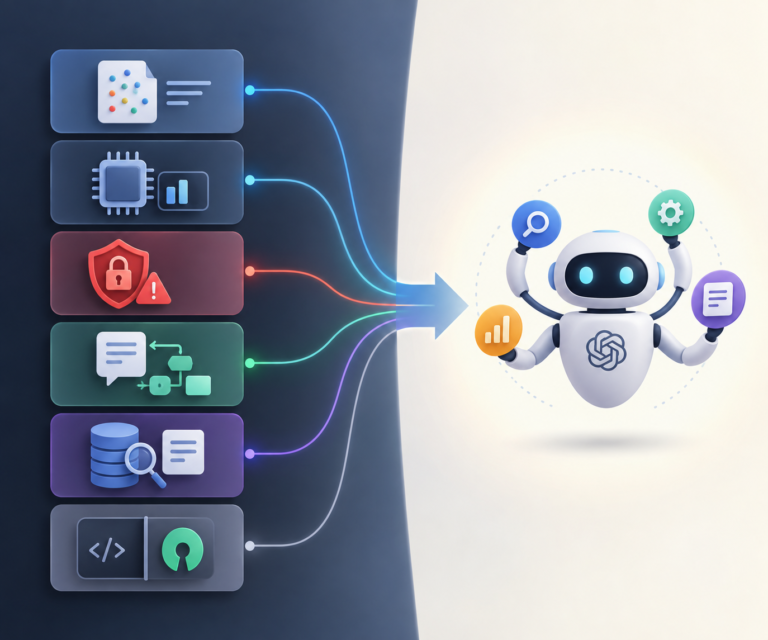
We’re often dealing with dozens or hundreds of applications — internal systems, vendor APIs, SaaS platforms — each with its own documentation, authentication model, update schedule, and quirks.
As these AI agents scale, your team has to:
Manually define every tool an LLM can call
Handle authentication and rate limits
Parse or reformat results for compatibility
Update definitions when the upstream API changes
Monitor for breaking changes
At some point, your AI agents become just another legacy integration problem — complex, fragile, and costly to maintain.
Enter MCP: Model Context Protocol
MCP (Model Context Protocol) is a standardised protocol that defines how LLMs can interact with external applications through a uniform server interface.
Instead of integrating tools manually into your LLM logic, each external application can be accessed through a pre-written MCP server.
What an MCP Server Does:
Represents a specific external application (e.g., Google Calendar, GitHub, Slack)
Exposes a list of available tools/actions the LLM can use
Handles API calls, payload formatting, and error responses
Abstracts away low-level API details and changes
It’s similar to how protocols like REST API, HTTP, or TCP help standardise communication in software systems.
How It Works (At a High Level)
The LLM queries an MCP server
“What tools do you support?”
The server responds with a standard description
Tool names, inputs, expected outputs
The LLM selects and invokes tools as needed
Using the protocol-defined interface
You don’t need to define the tool or write glue code. You just point to the right MCP server.
Strategic Implications for IT Leaders
Here’s why this matters:
Simplifies AI Tooling at Scale
You can connect hundreds of tools to LLMs without writing hundreds of wrappers.
Future-Proofs Integrations
If a vendor updates their API, the MCP server can be updated independently — no need to redeploy your LLM systems.
Supports Modular Architectures
MCP aligns with service-oriented design: each server is isolated, testable, and replaceable.
Encourages Reuse Across Teams
A finance team and an HR team can reuse the same MCP server for tools like Google Sheets or Slack — no duplication of effort.
You can also build and publish your own MCP servers for internal systems.
A Note on Security
With convenience comes risk. As with any third-party layer, MCP servers should be audited and sandboxed before use. You’re delegating sensitive operations — choose carefully or host your own servers.
More on security implications in a future post.
Final Thoughts
If you’re managing AI infrastructure at the enterprise level, MCP is not just a nice-to-have — it’s a serious enabler.
It reduces custom code, increases reliability, and helps your LLM agents scale beyond toy examples.
Instead of fighting the integration mess, you focus on what matters: Designing intelligent, adaptable systems that deliver real business value.
The most up-to-date AI + Gen AI Coaching for senior IT professionals
In case you are looking to learn AI + Gen AI in an instructor-led live class environment, check out these courses